We rebuilt The Heinrich Firm’s Duda site into a high-performance Next.js platform with perfect Lighthouse scores
A 12-week legal website migration focused on speed, credibility, and scalable content architecture.
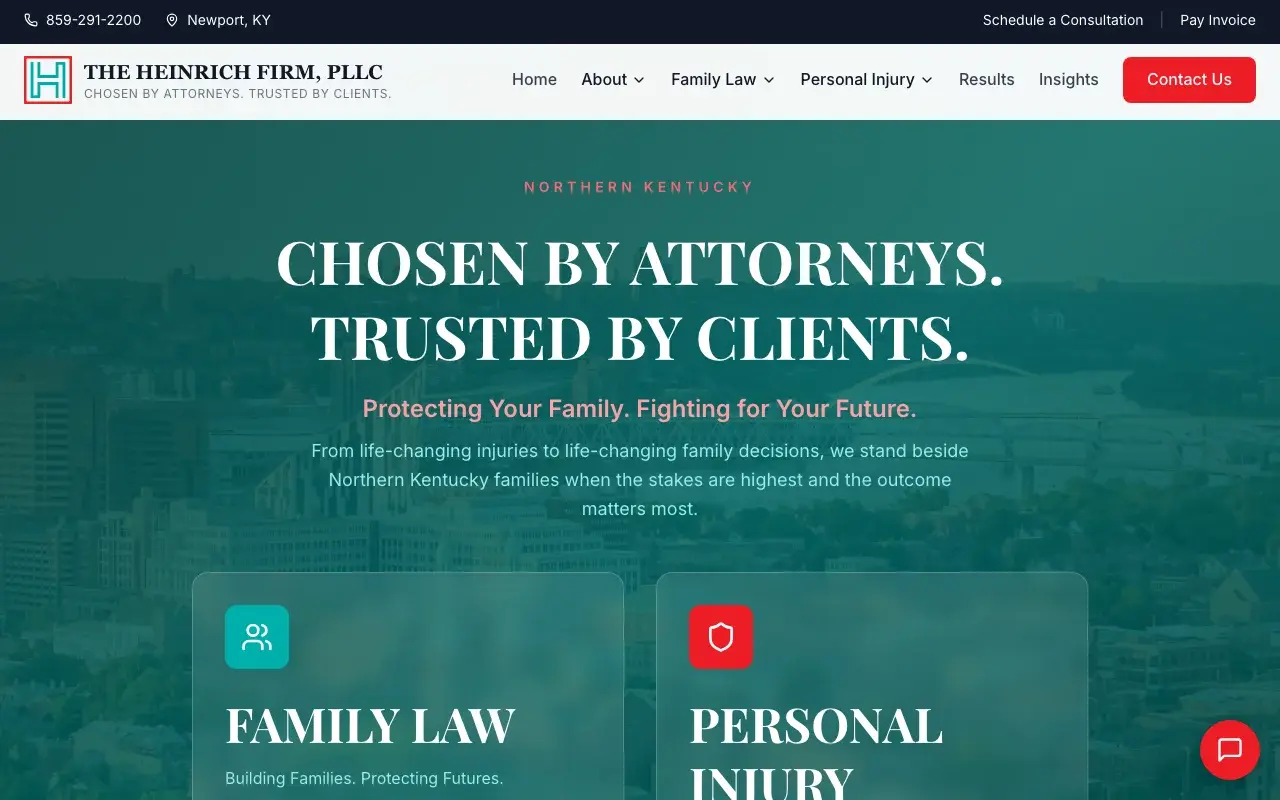


We took The Heinrich Firm’s aging Duda site-builder website and rebuilt it as a modern Next.js application designed for performance, accessibility, and long-term growth. The result was a 184-page legal website that launched with a 100/100 Lighthouse Performance score, 100/100 SEO score, and a cleaner foundation for conversion-focused content.
View live site- Website Migration
- Next.js Development
- Information Architecture
- Performance Optimization
- Technical SEO Foundation
- Accessibility Improvements
Challenges & Solutions
What stood in the way, and how we cleared it.
The site builder shipped a heavy payload on every page
The old homepage came in at about 120KB of builder-generated HTML, plus jQuery, a jQuery migrate shim, the platform’s shared runtime bundle, and two separate analytics libraries. All of it was served by the builder and its reseller, not added by the firm.
We rebuilt the site in Next.js with route-based code splitting, lean component architecture, and only the code required for each page.
Practice area pages sat behind builder-generated URLs
Every interior page lived at an address like /custody/3826625, and the homepage carried two H1 headings, the second of which was the firm’s street address. The structure suited the builder rather than the people and search engines reading it.
We designed a custom page system in Next.js that gave us full control over layout, content hierarchy, calls to action, and reusable legal service templates.
The legacy site lacked persuasive content architecture
The site analysis showed a homepage shell with weak content hierarchy, no visible persuasive messaging, limited trust signals, and unclear consultation pathways.
We rebuilt the information architecture around legal practice area discovery, consultation CTAs, attorney credibility, local trust signals, and stronger internal linking.
The site lived inside a reseller’s account
The firm’s site ran on a Duda instance resold through Hibu. Even the privacy, cookie, and terms links in the footer pointed at the reseller’s own pages rather than anything belonging to The Heinrich Firm.
We rebuilt the site as a standalone Next.js application that isn’t tied to a builder platform or a reseller account.
Our Strategy
A phased approach to delivering measurable results.
Platform audit and migration planning
We started by evaluating the limitations of the existing Duda implementation, identifying performance bottlenecks, content gaps, and structural issues that were holding the site back.
- Duda site architecture review
- Migration roadmap
- Content inventory
- Template requirements
- Performance and SEO baseline assessment
Information architecture and legal UX planning
We restructured the site around what prospective legal clients actually need: clear service pathways, trust-building content, and direct consultation opportunities.
- Revised sitemap
- Homepage content hierarchy
- Practice area page framework
- CTA strategy
- Internal linking plan
Next.js design and development
We rebuilt the site as a custom Next.js application, moving off the builder’s page templates to reusable components and performance-first layouts.
- Custom Next.js frontend
- Responsive component library
- Reusable page templates
- Optimized routing structure
- Image and asset optimization
Technical SEO and accessibility implementation
We implemented a clean technical foundation to support discoverability, crawlability, and usability from launch.
- Metadata framework
- Semantic heading structure
- Accessibility improvements
- Technical SEO setup
- Structured page-level optimization
QA, launch, and post-launch validation
Before launch, we validated site performance, responsiveness, and implementation quality across the full build to ensure a strong production release.
- Cross-device QA
- Launch checklist
- Lighthouse validation
- Accessibility review
- Production deployment support
Results
Measurable outcomes that speak for themselves.
Best-practice implementation across the build
The live audit confirmed that the site met modern web implementation standards with no compromise in technical quality.
MeasuredAccessibility improved to a strong production standard
We built the site with accessibility in mind, resulting in a high live audit score and a better experience for more users.
MeasuredLarge-scale content foundation delivered
We developed a 184-page site architecture that gave the firm a scalable framework for legal service content, local visibility, and future expansion.
MeasuredConversion-oriented legal UX foundation
We transformed a weak homepage shell into a structured legal website experience designed to improve trust, clarify services, and support consultation inquiries.
EstimatedPerformance
Desktop Lighthouse, measured September 7, 2026.
Site Architecture
184 pages structured across 6 content categories with 16,799 words of content.
Tech Stack
The technologies and tools powering this project.
We used Next.js to replace Duda with a faster, more scalable application architecture that supported SSR, SSG, and modern performance optimization.
We built the interface in React to create reusable components, flexible layouts, and a maintainable design system.
We used modern JavaScript to power interactive components and client-side functionality across the site.
We structured content with semantic HTML to improve accessibility, SEO, and content clarity.
We used modern CSS to create a responsive, polished visual system tailored to a professional legal brand.
The firm’s previous site ran on Duda, a hosted site builder resold through Hibu. We migrated off it to a custom Next.js build.
We used Lighthouse to validate performance, SEO, accessibility, and best-practice outcomes before and after launch.
Services Provided
A breakdown of the services delivered for this project.
Duda to Next.js Migration
We migrated The Heinrich Firm from a legacy Duda site-builder setup to a modern Next.js application built for speed, flexibility, and long-term maintainability.
- Legacy platform replacement
- Modern React-based architecture
- Template and content migration planning
- 184 pages delivered
Custom Legal Website Development
We designed and developed a custom site experience tailored to the needs of a law firm, with stronger service discovery and consultation pathways.
- Custom page templates
- Responsive frontend development
- Practice area page structure
- Trust-focused homepage design
Performance Optimization
We engineered the site for speed from the ground up using Next.js capabilities and a lean frontend approach.
- Route-based code splitting
- Optimized assets
- Efficient rendering strategy
- Performance-first build decisions
Technical SEO Foundation
We implemented the structural elements needed for search visibility, crawlability, and scalable content publishing.
- Metadata framework
- Semantic page structure
- Internal linking support
- SEO-ready content architecture
Accessibility and QA
We validated the build across devices and usability standards to ensure the site launched with a polished, production-ready experience.
- Accessibility review
- Cross-browser QA
- Responsive testing
- Launch validation
Project Details
Need a legal website that builds trust before the first consultation?
We help law firms move beyond outdated platforms and launch high-performance websites built to showcase practice areas, strengthen credibility, and drive more qualified inquiries.