

Today
One corporate site with every community buried in a dropdown
With Upforge
A leasing site per community, each ranking on its own name and address
Built for Property Management
We build the leasing side: a real website per community, portfolio sites that hold a whole market, vanity domains that land on the right property, and tour and application flows that run at 9pm on a Sunday. We do this today for Manhattan Development Group: six sites across eleven domains. The resident-facing software is a separate build, and it has its own page: property management platforms and tenant portals.
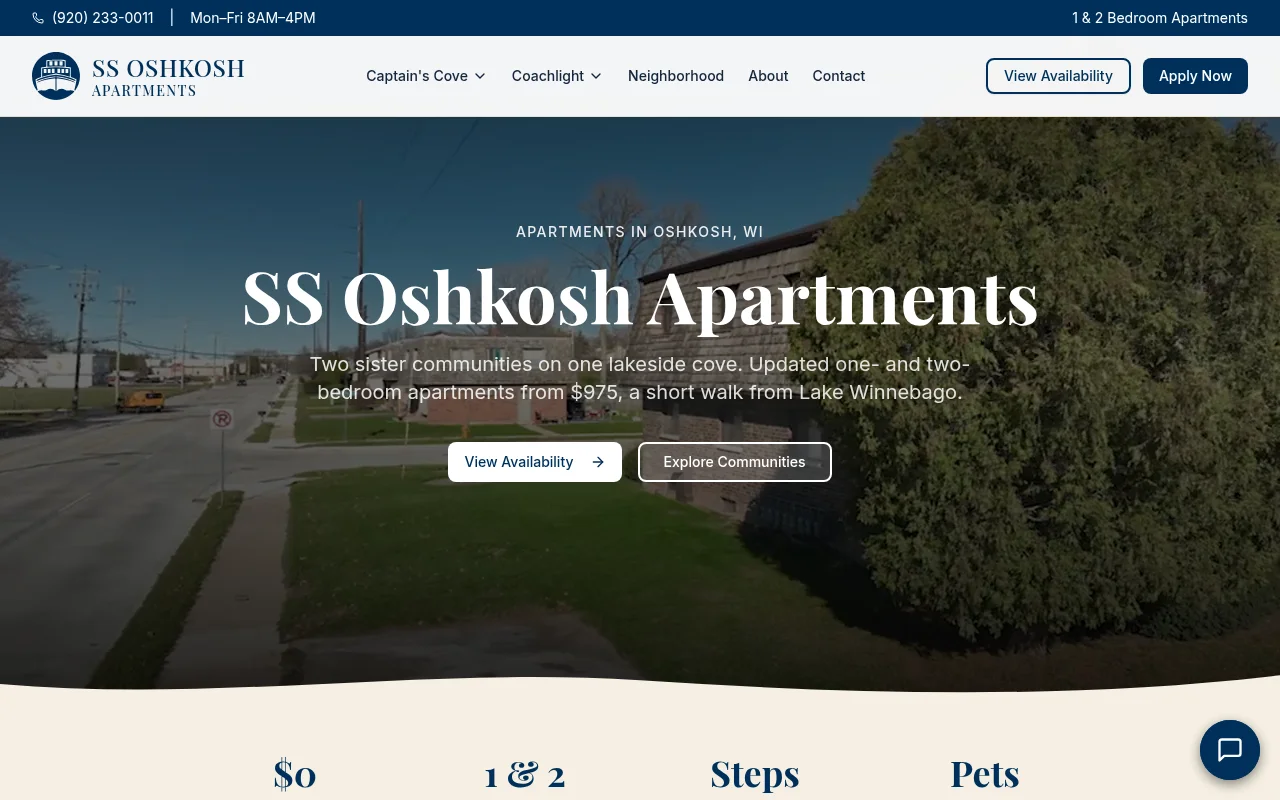
Our work · SS Oshkosh Apartments, built by Upforge
Tour24's data from First Communities' 59,000-unit portfolio: 54% of self-guided tours were completed outside office hours and 36% landed on a Saturday or Sunday. If touring requires reaching a leasing agent, that demand doesn't reschedule. It goes to the community that let them in. (Tour24 / First Communities (Business Wire press release), 2023)
Zego's 2026 Resident Experience Management Report puts one turn at roughly $4,000 in multifamily. Sites usually get built for prospects and then ignore the people already paying rent, which is exactly backwards. Renewals are cheaper than lease-ups. (Zego, 2026)
Apartments.com, Zillow Rentals, and Rent.com are where renters start, and there's nothing wrong with paying for that. The problem is when a renter searches your community by name afterward and finds a corporate page with a dropdown instead of the property. That's the listing site paying for the interest and then collecting it again.
Today
One corporate site with every community buried in a dropdown
With Upforge
A leasing site per community, each ranking on its own name and address
Today
Apartments.com, Zillow Rentals, and Rent.com own the whole funnel
With Upforge
Your own sites take direct inquiries, so the listing spend is a channel and not the channel
Today
A contact form, an office phone, and hours nobody can make
With Upforge
Tour scheduling, availability, and an application anyone can start at midnight
A renter searching a community by name is the warmest traffic you'll ever get, and sending them to a corporate site with a property dropdown wastes it. We build each community its own site: unit mix and floor plans with real availability, photography and a map, pet and parking policy, current concessions, and a tour request that lands attributed to that property. Abbey Glen, Chapel View, and The Gateway Flats each run this way for Manhattan Development Group.
Learn more about A Leasing Site Per CommunityWhen one company holds several communities in a market, a portfolio site is the better shape: one site people can browse across properties, with each community on its own page. Every community still gets a memorable domain of its own that 301s straight to its page, so it can go on a yard sign or a postcard without a URL nobody can retype. Green Bay runs three vanity domains into one portfolio site, and Oshkosh runs two. That's one codebase and one place to update rent, with a front door for every property.
Learn more about Portfolio Sites With a Vanity Domain Per PropertyLeasing traffic peaks after the office closes. We wire the site so a prospect can check what's actually available, book a tour into your calendar, and start an application without reaching anyone. The same site serves the people already living there, which is where renewals get won. If that path needs to run all the way through screening, payments, and a resident portal, that's custom software rather than a website. It's a separate build, and it has its own page.
Learn more about Tour, Apply, and Renew Without a Phone CallThe free audit checks your website the way your property management customers experience it (speed, mobile, accessibility, and search visibility) and puts what's worth fixing in writing. It's automated and free, and the report is specific about what it finds.
A renter searching a community by name lands on that community, not on a portfolio dropdown. Each site competes on its own name, address, and neighborhood, and every inquiry still arrives tagged with the property that produced it.
Listing sites stay in the mix. The difference is that the name search which follows a listing now lands on your site, so a share of the funnel arrives direct rather than being sold back to you.
Availability, tour scheduling, and the start of an application all work at 9pm on a Sunday. The prospect who can't call during the day becomes a booked tour instead of a lost lead.
The people already living there use the same site for the portal, a work order, or a renewal. Turnover is the expensive event in this business, so a site aimed only at prospects is doing half the job.
Already built and running
mdg.one is the company site behind everything below: who the group is, what it holds, and a path into each community's own site rather than a directory dead end.
Read the case studyAbbey Glen (abbeyglenapts.com), Chapel View (chapelviewone.com), and The Gateway Flats (thegatewayflats.com) each run as their own site, with unit mix, availability, photography, and a tour request that lands attributed to that property.
See all three in the gallerygreenbayapartmentrentals.com holds the market's communities in one place, and georgetowngb.com, tallpinesgb.com, and westbrookegb.com each 301 into their own /properties page. A memorable domain per community, one site to maintain.
Visit the live sitessoshkoshapts.com carries the Oshkosh properties, with coachlightliving.com and captainscoveapts.com redirecting to their community pages. Six apartment sites and eleven domains across the communities, before you count the condo side.
Read the case studyA condominium community that came to us on Wix, where performance and SEO control were both capped. We migrated it to Next.js and rebuilt the structure around how someone actually shops a residence: the units, the finishes, and what living there is like. It launched at 95 Performance with 100 on SEO and Accessibility, measured on the live site.
Read the case studyLive, right now
The parent company site
Who the group is and what it holds, with a path into each community's own site rather than a directory dead end.
Visit mdg.onePortfolio site, three vanity domains
One site across the market's communities. georgetowngb.com, tallpinesgb.com, and westbrookegb.com each 301 into their own property page.
Visit greenbayapartmentrentals.comPortfolio site, two vanity domains
The same pattern in a second market. coachlightliving.com and captainscoveapts.com redirect to their community pages.
Visit ssoshkoshapts.comExplore the three single-community sites: abbeyglenapts.com, chapelviewone.com, and thegatewayflats.com. That's six sites across eleven domains, all for one management company.
Tell us where the hours are going, and we’ll show you what a system built for your operation looks like, with a fixed price before any work starts.