
The Closet Designer That Turned a Two-Hour Quote Into Ten Minutes
A 3D configurator, an AI design partner, and a signed contract in one sitting
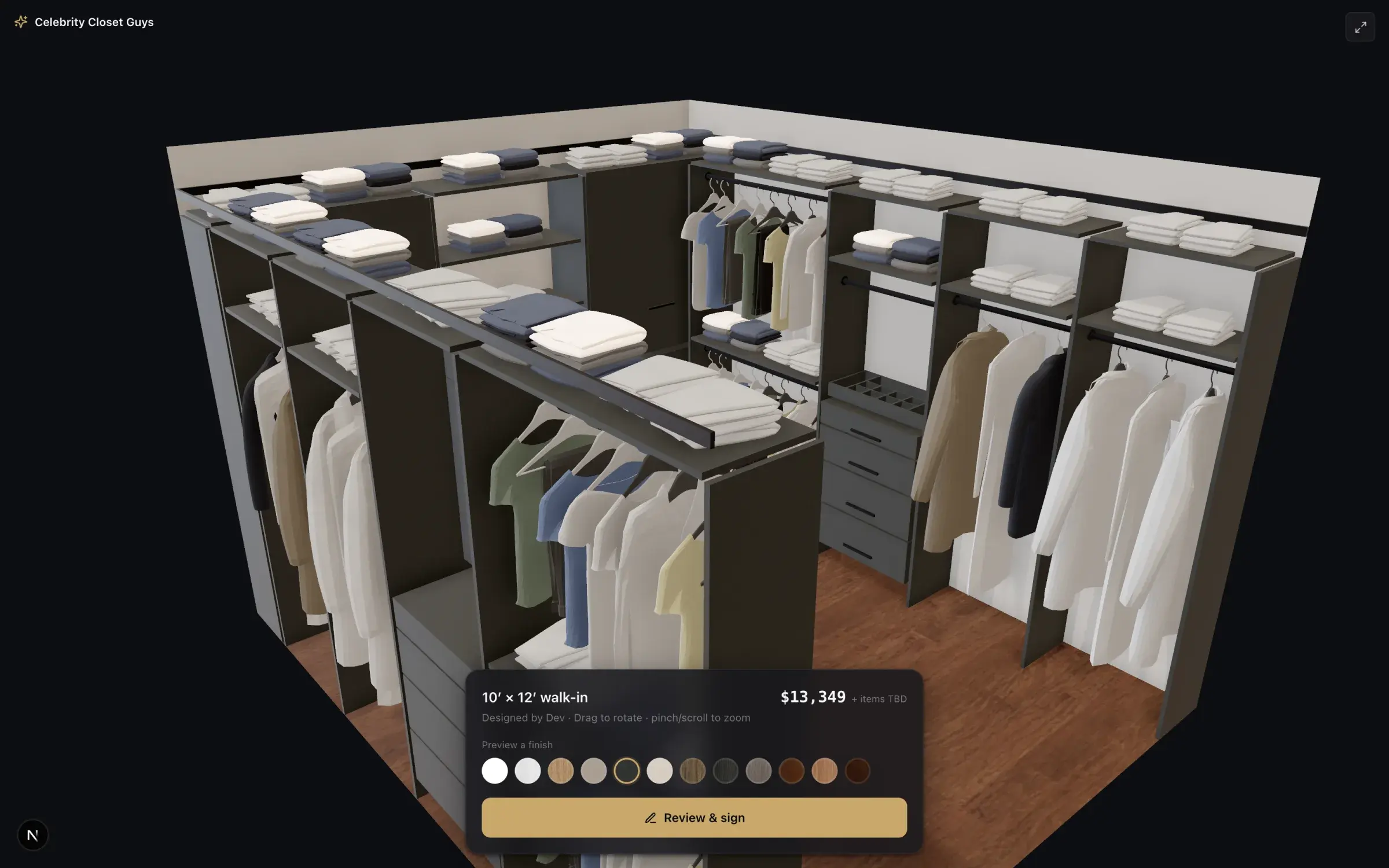
Celebrity Closet Guys designs and installs custom closets from Organized Living's catalog. Their design work lived inside Organized Living's own dealer software, where turning a customer conversation into a priced, presentable design took about two hours. We built the replacement: a browser-based 3D closet designer with an AI that builds entire rooms from a sentence, dealer-cost pricing the customer never sees, a shareable 3D walkthrough, e-signature, and a Square deposit. Design-to-customer time went from two hours to ten minutes.
View live site- Custom Software Development
- 3D Web Application
- AI Integration
- E-Signature & Payments
- Systems Architecture
Challenges & Solutions
What stood in the way, and how we cleared it.
Designing a closet took about two hours, inside someone else's software
Every design ran through Organized Living's dealer tool. It could produce a correct design, but the path from what the customer wanted to something they could look at and price took roughly two hours. Designs happened after the appointment rather than during it, and the customer left the room without a number.
We built a purpose-made 3D designer around the same Organized Living catalog: 357 products and 20 finishes, using the manufacturer's own 3D models where they exist and parametric geometry where they do not, so a designer drags real orderable parts into a real room and watches the price update as they go.
Building a full room by hand is slow, even in a fast tool
Placing every shelf, rod, and drawer bank by hand is mechanical work, and it is where mistakes enter: a rod spanning too far unsupported, a column that misses the deck line, an island that leaves no aisle.
We added an AI design partner architected so the model never touches geometry. It emits a constrained plan of which wall gets which functional zones and in what proportion, and a deterministic engine converts that into exact coordinates against real product SKUs. A separate critic scores the result and repairs it. The rules come from real closet ergonomics: a fixed mounting-height ladder, garment fall lengths, reach ranges, and ADA aisle minimums.
The customer had to take the design on faith
A quote a customer cannot see inside is a quote they have to trust. Nothing let them walk their own closet, try a different finish, or say yes on the spot.
Every design gets a share link that opens a fullscreen 3D walkthrough with no login. The customer orbits the room, swaps finishes live, signs with a drawn signature and typed name, and pays a deposit through Square checkout that hands them back to the same proposal when it's done.
Dealer cost and customer price in one system is a margin leak
The designer needs to see cost and margin. The customer must never see either. Ship the same catalog to both and anyone with developer tools can total the cost and read the markup straight off the wire.
Dealer cost is stripped from the catalog before it reaches a customer browser, and the customer payload carries no ambiguous total field at all, because a single ambiguous total is exactly how a charge ends up computed from cost instead of price. Money is integer cents with exactly one rounding point, so an itemized contract always sums to its own total.
A signature and a payment have to be provably correct
A design can change between the moment it is priced and the moment it is signed, and a deposit link can be pointed at the wrong contract. Both failure modes cost real money.
Signing freezes the design, the price, and the exact revision in a single first-signature-wins operation: if the design moved in between, nothing is written at all rather than pinning a price and a design from two different versions. Deposit verification refuses to trust a paid flag, checking that the sale is the right kind and the right size with both a floor and a ceiling, and failing closed.
Our Strategy
A phased approach to delivering measurable results.
Capturing the catalog
We captured the Organized Living dealer catalog and its 3D assets, normalizing 357 products, 35 categories, and 20 finishes into a structure the app could price and render.
- Catalog normalization
- 3D asset pipeline
- Finish system
- Pricing data model
Building the 3D studio
We built the designer surface: drag-and-drop placement with snap-to-fit, undo and redo, autosave, a measurement HUD, and two render paths so high-fidelity manufacturer models and parametric parts coexist in one scene.
- React Three Fiber studio
- Snap and drag system
- Scene state with undo
- Parametric geometry engine
Teaching an AI to design closets
We split the AI in two: a model that plans zones and a deterministic engine that builds geometry, with a critic scoring the output against closet ergonomics and repairing it. The rules were reverse-engineered from the manufacturer's own tool and professional standards.
- Constrained planning layer
- Deterministic wall engine
- Design critic and repair loop
- Ergonomics rule module
Closing the sale in the room
We built the customer surface and the money path: a no-login 3D walkthrough, live finish swapping, e-signature with a contract freeze, Square deposits verified server-side, and branded PDFs for the customer and an order sheet for the shop.
- Customer proposal viewer
- E-signature and contract freeze
- Square deposit verification
- Signed PDF and order sheet generation
Results
Measurable outcomes that speak for themselves.
Two hours to ten minutes
The owner's own assessment of how long it now takes to get from conversation to a priced design the customer can see.
One link from design to deposit
Share, walkthrough, finish swap, signature, and payment are a single flow rather than four disconnected steps.
Orderable by construction
Designs are built from real catalog SKUs, and product lines are distinguished structurally so a closet sold as one line can never be ordered as another.
Tech Stack
The technologies and tools powering this project.